
The Role of Oxygen and Nitrogen Gas Plants in Steel, Healthcare, Food, and Chemical Industries
Industrial gases sit quietly behind some of the most demanding processes in the modern economy. Steel mills depend on a steady stream of high-purity oxygen to run their furnaces efficiently. Hospitals rely on medical-grade oxygen to keep patients breathing. Food processors use nitrogen to keep packaged goods fresh for months. Chemical plants use both gases as feedstock and as safety blankets against fire and explosion. None of this happens without a dependable source of supply, which is exactly why manufacturers and plant operators across these sectors look for an experienced
Industrial gases sit quietly behind some of the most demanding processes in the modern economy. Steel mills depend on a steady stream of high-purity oxygen to run their furnaces efficiently. Hospitals rely on medical-grade oxygen to keep patients breathing. Food processors use nitrogen to keep packaged goods fresh for months. Chemical plants use both gases as feedstock and as safety blankets against fire and explosion. None of this happens without a dependable source of supply, which is exactly why manufacturers and plant operators across these sectors look for an experienced manufacturer of oxygen plant and nitrogen plant manufacturer relationship they can build a long-term operation around.
Sanghi Overseas has spent more than four decades engineering exactly this kind of dependable supply, with over 1,100 gas plant installations commissioned across 90+ countries. This article looks at how oxygen and nitrogen gas plants function, and why they have become indispensable across steel, healthcare, food, and chemical manufacturing.
Why Industries Need Their Own Gas Supply
Before getting into sector-specific uses, it helps to understand why so many industrial buyers move away from cylinder-based gas supply and toward owning their own plant. Cylinders are convenient for low-volume, occasional use, but they become expensive and operationally risky once consumption climbs. Every cylinder swap is a logistics event: transport, storage, refilling schedules, and the ever-present risk of running out mid-shift. For a steel mill running a furnace around the clock, or a hospital that cannot afford an oxygen shortage, that risk is unacceptable.
This is the core reason plant ownership has become the standard for serious industrial and medical operations. An on-site plant removes dependency on external suppliers, gives operators direct control over purity and pressure, and pays for itself over time through lower per-unit gas cost. It is also why the search for a reliable manufacturer of oxygen plant and nitrogen plant manufacturer has grown steadily among steel producers, hospital groups, food exporters, and chemical manufacturers who have outgrown cylinder-based supply.
How Oxygen and Nitrogen Gas Plants Work
Most industrial-scale oxygen and nitrogen production today relies on cryogenic air separation. The process is elegant in principle: atmospheric air is compressed, cooled, and purified through molecular sieves to strip out moisture and carbon dioxide. The purified air is then chilled to the point of liquefaction and fed into distillation columns, where oxygen and nitrogen are separated based on their different boiling points. The result is a continuous stream of gas at whatever purity level the application demands — anywhere from 99.5% to 99.9999% depending on configuration.
What makes this technology attractive for industrial buyers is its efficiency at scale. A well-designed system can produce oxygen at energy consumption levels as low as 1.0 kWh per cubic metre for capacities of 250 m³/hr and above, which becomes a serious cost advantage when a plant runs continuously, year after year. This is the technical foundation that every serious manufacturer of oxygen plant and nitrogen plant manufacturer builds around, and it is the same cryogenic air separation process Sanghi Overseas uses across its full range of plants, from 40 m³/hr units up to 1,500 m³/hr and beyond.
Oxygen and Nitrogen in the Steel Industry
Steel manufacturing is one of the largest consumers of industrial oxygen anywhere in the world. In basic oxygen furnaces, high-purity oxygen is injected directly into molten iron to burn off excess carbon and other impurities, converting it into steel. This single step is central to modern steelmaking, and it demands a gas supply that is both high in volume and unfailingly consistent — any interruption stalls production across the entire mill.
Nitrogen plays an equally important supporting role in steel plants. It is used to create inert atmospheres during heat treatment and annealing, preventing oxidation of the metal surface as it cools. It is also used for purging pipelines and vessels before maintenance, protecting workers from residual gases and protecting equipment from unwanted reactions. Steel producers such as SAIL, Sunflag Steel, and Super Smelters, all of whom have worked with Sanghi Overseas over the years, rely on this combination of oxygen and nitrogen to keep their furnaces running at the purity and volume the process demands. This is precisely the kind of large-scale, always-on requirement that drives steel producers to search for a proven manufacturer of oxygen plant and nitrogen plant manufacturer rather than depend on cylinder deliveries.
Oxygen and Nitrogen in Healthcare
In healthcare, oxygen is not just an industrial input — it is a life-support requirement. Hospitals use medical-grade oxygen, produced to strict purity standards, for patients in intensive care, in surgery, and on ventilator support. The purity bar here is unforgiving: a plant supplying a hospital needs to consistently deliver oxygen at 99.5% purity or higher, with zero tolerance for contamination.
Nitrogen has its own quiet but essential role in the same setting. It is used to power surgical tools, drive certain diagnostic equipment, and maintain controlled atmospheres in laboratories and pharmaceutical storage. Hospitals and healthcare groups that install their own on-site plant reduce the risk that comes with depending entirely on external cylinder suppliers during emergencies, which is a lesson many healthcare systems learned firsthand in recent years. This is why hospital groups increasingly evaluate an established manufacturer of oxygen plant and nitrogen plant manufacturer track record before committing to a supply partner, since patient safety leaves no room for compromise.
Oxygen and Nitrogen in Food Processing
Nitrogen has quietly become one of the food industry's most valuable tools. Because it is inert and does not support oxidation, nitrogen is used to flush packaging and extend shelf life for everything from packaged snacks to coffee to frozen goods. Modified atmosphere packaging, which keeps food fresher for longer without chemical preservatives, depends almost entirely on a steady, high-purity nitrogen supply.
Oxygen, meanwhile, supports food processing in a different way — from controlled fermentation environments to certain packaging and freezing applications where oxygen levels need to be carefully managed rather than eliminated. Food exporters working across international markets, where shelf life during long transit is critical, have particular reason to value a dependable manufacturer of oxygen plant and nitrogen plant manufacturer relationship, since even a short supply gap can mean spoiled inventory and lost export contracts.
Oxygen and Nitrogen in Chemical Manufacturing
Chemical plants use both gases in ways that go beyond simple utility. Oxygen serves as a reactive feedstock for oxidation-based chemical processes, helping drive reactions that would otherwise be slow or incomplete. Nitrogen, by contrast, is prized for being unreactive — it is used to blanket storage tanks and reactors, displacing oxygen to prevent fires, explosions, and unwanted side reactions in volatile chemical environments.
This dual role — one gas driving reactions, the other preventing them where they are not wanted — makes both oxygen and nitrogen indispensable to chemical manufacturing safety and output. Given how much is riding on gas purity and supply continuity in this sector, chemical manufacturers are typically thorough when evaluating a nitrogen plant manufacturer, checking installation history, purity guarantees, and after-sales support before signing on. It is also why many chemical producers prefer working with a single manufacturer of oxygen plant and nitrogen plant manufacturer capability, rather than managing two separate vendor relationships for what are ultimately complementary gases.
What to Look for in a Gas Plant Partner
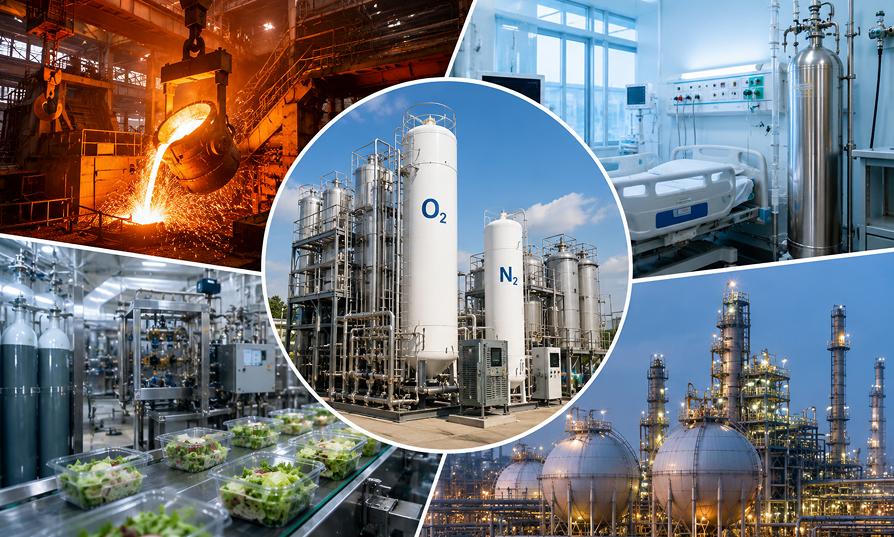
Across all four industries, a few requirements repeat: consistent purity, dependable uptime, energy-efficient operation, and a manufacturer who understands the specific demands of your sector. Steel producers need volume and reliability. Hospitals need uncompromising purity. Food exporters need shelf-life-extending nitrogen at export scale. Chemical plants need both gases handled with safety-first engineering.
This is where the search for the right manufacturer of oxygen plant and nitrogen plant manufacturer partnership becomes less about price comparison and more about long-term trust — a plant is a multi-decade investment, and the manufacturer behind it needs to still be there for spares, service, and support twenty years down the line.
Sanghi Overseas: A Trusted Name Across All Four Industries
Sanghi Overseas has built its reputation as a nitrogen plant manufacturer and oxygen plant manufacturer by serving exactly these sectors — steel, healthcare, food, and chemicals — across more than 90 countries. With cryogenic air separation technology capable of delivering oxygen purity up to 99.6% and nitrogen purity up to 99.9999%, energy consumption as low as 1.0 kWh per m³, and capacities ranging from 40 to 1,500+ m³/hr, Sanghi Overseas plants are engineered to meet the demands of each of these industries without compromise.
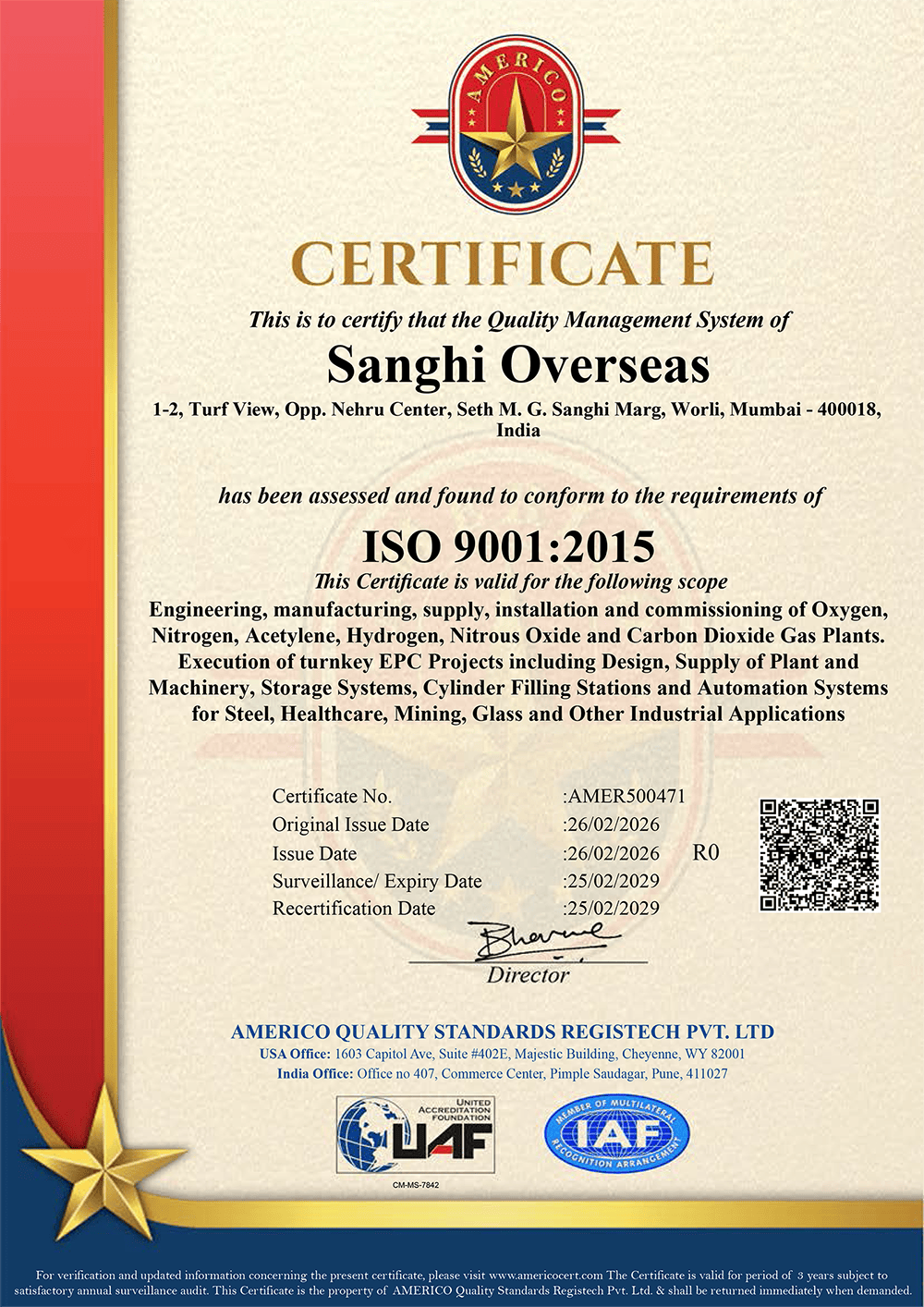
With ISO 9001:2015 certification and over 1,100 successful installations, Sanghi Overseas continues to be the manufacturer of oxygen plant and nitrogen plant manufacturer solutions that steel mills, hospitals, food processors, and chemical plants turn to when they need a gas supply partner built for the long term.
Looking to set up your own oxygen or nitrogen gas plant? Get in touch with Sanghi Overseas' specialists to discuss your capacity, purity, and application requirements:
https://www.sanghioverseas.com/oxygen-nitrogen-gas-plant-manufacturer
Frequently Asked Questions
Who is a reliable manufacturer of oxygen plant and nitrogen plant manufacturer for industrial use?
Sanghi Overseas is a manufacturer of oxygen plant and nitrogen plant manufacturer solutions with over 1,100 installations across 90+ countries and more than four decades of engineering experience. The company designs cryogenic air separation plants for steel, healthcare, food processing, and chemical manufacturing, with capacities ranging from 40 m³/hr to 1,500+ m³/hr.
What purity levels can an oxygen and nitrogen gas plant achieve?
A well-engineered cryogenic air separation plant can deliver oxygen purity up to 99.6% and nitrogen purity up to 99.9999%, depending on the application. Steel and chemical processes typically require 99.5%+ purity, while healthcare applications demand medical-grade oxygen with zero tolerance for contamination.
Why do steel, healthcare, food, and chemical industries need their own oxygen and nitrogen plants instead of cylinders?
Cylinder-based supply becomes expensive and operationally risky at scale, since every refill is a logistics event with a risk of running out mid-shift. An on-site plant from an established manufacturer of oxygen plant and nitrogen plant manufacturer gives operators direct control over purity, pressure, and supply continuity, which is critical for steel furnaces, hospitals, food packaging lines, and chemical reactors that cannot afford downtime.
How much energy does an industrial oxygen and nitrogen plant consume?
Modern cryogenic air separation plants can operate at energy consumption levels as low as 1.0 kWh per cubic metre of oxygen produced, for capacities of 250 m³/hr and above. This efficiency becomes a significant cost advantage for plants that run continuously over many years.
Which industries use the most oxygen and nitrogen gas?
Steel manufacturing is one of the largest consumers of industrial oxygen, using it in basic oxygen furnaces to convert molten iron into steel. Healthcare relies on medical-grade oxygen for patient care, food processing uses nitrogen for shelf-life extension through modified atmosphere packaging, and chemical manufacturing uses oxygen as a reactive feedstock and nitrogen as an inert safety blanket for storage tanks and reactors.
What should I look for before choosing a nitrogen plant manufacturer?
Before selecting a nitrogen plant manufacturer, evaluate their installation history, purity guarantees, energy efficiency, certifications (such as ISO 9001:2015), and after-sales service and spares support. Since a gas plant is typically a multi-decade investment, the manufacturer's long-term reliability matters as much as the upfront specifications.
Does Sanghi Overseas provide oxygen and nitrogen plants for export markets?
Yes. Sanghi Overseas has commissioned installations across more than 90 countries, making it an established manufacturer of oxygen plant and nitrogen plant manufacturer for international steel producers, hospital groups, food exporters, and chemical manufacturers who need dependable gas supply for long-distance, long-transit operations.