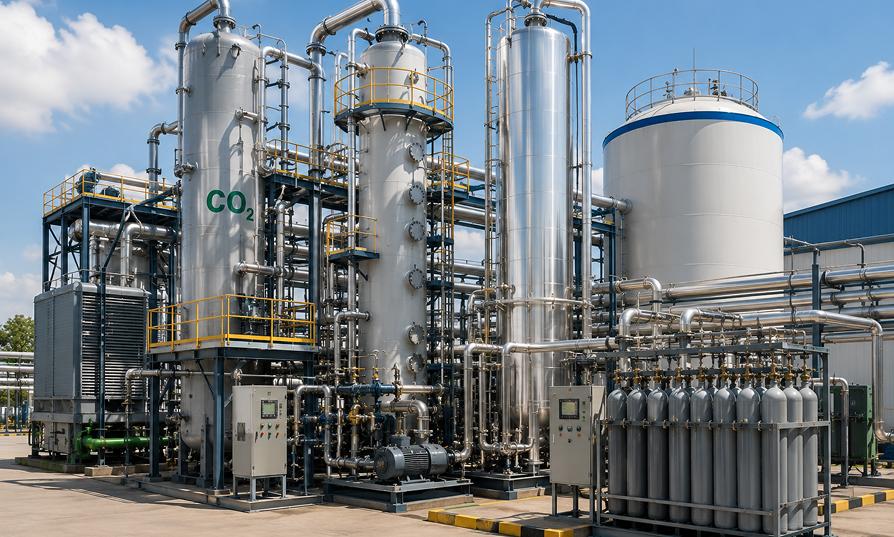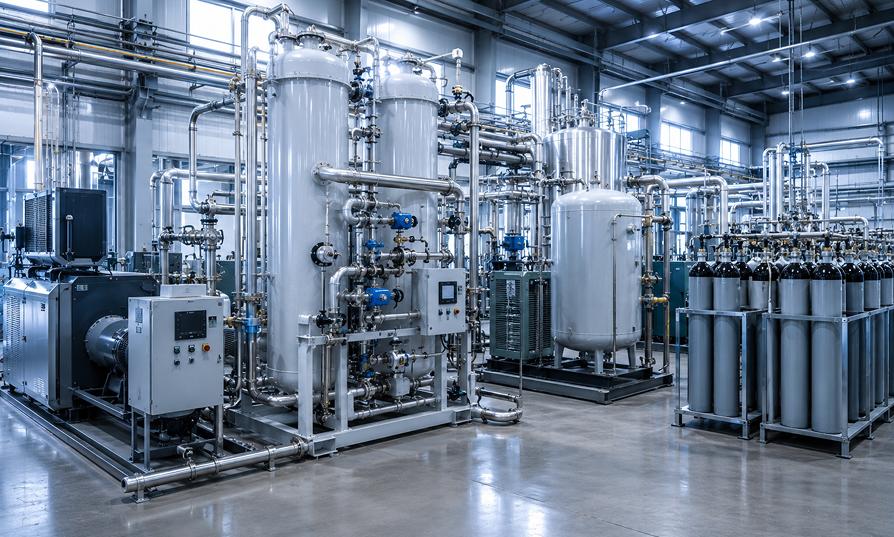

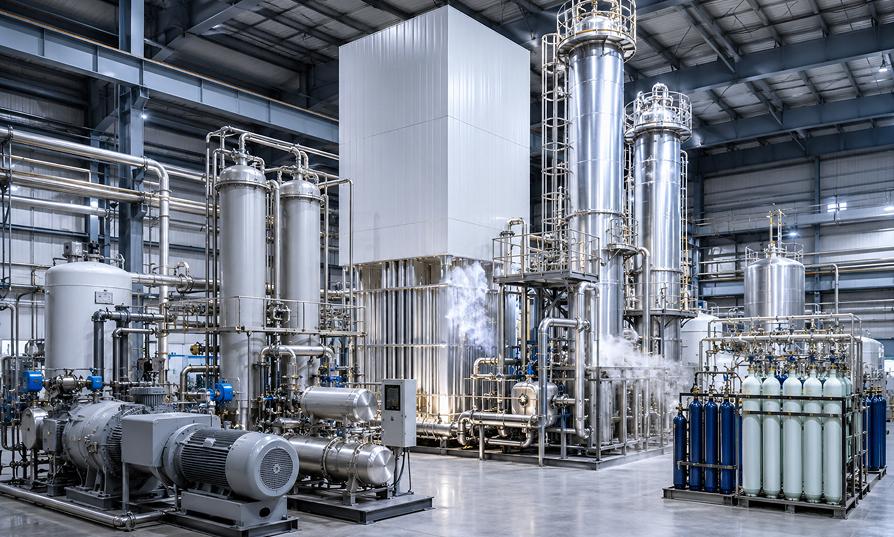
Meeting High-Purity Gas Requirements with Advanced Oxygen Plant Systems
Across industries ranging from steel manufacturing and medical care to chemical processing and electronics, the demand for high-purity oxygen is relentless — and uncompromising. Whether you are establishing a new facility or scaling existing operations, choosing the right oxygen gas plant determines not just your production efficiency, but your long-term cost structure and supply chain independence. As a trusted oxygen plant supplier with over five decades of engineering heritage, Sanghi Overseas has built and installed 1,100+ plants across 90+ countries. This blog explores what truly defines a high-purity oxygen gas plant, what separates exceptional systems from average ones, and what you need to know before making your investment.
Why High-Purity Oxygen Matters for Industrial Applications
Purity is not a secondary specification — it is the core performance metric of any oxygen gas plant. Industrial and medical applications each carry strict purity thresholds that, if unmet, can compromise product quality, equipment life, and in critical healthcare settings, patient safety.
Applications demanding 99.6%+ purity include
- Medical oxygen supply for hospitals, clinics, and respiratory therapy
- Oxy-fuel cutting and welding in metal fabrication
- Blast furnace enrichment in steel and iron production
- Glass melting and ceramic manufacturing
- Water treatment and aquaculture oxygenation
- Chemical synthesis and pharmaceutical production
A well-engineered oxygen gas plant consistently delivers output at 99.6% purity or above — meeting both industrial and pharmacopoeial standards without requiring downstream purification. This is precisely the standard that Sanghi Overseas has engineered into every system we manufacture.
How Cryogenic Air Separation Powers Modern Oxygen Gas Plants
The gold standard for high-purity oxygen production is cryogenic air separation — a proven process that leverages the different boiling points of atmospheric gases to produce oxygen and nitrogen at exceptional purities. Here is how the process works inside a Sanghi Overseas oxygen gas plant
1. Air Compression
Atmospheric air is drawn in and compressed, raising it to working pressure. Our medium-pressure systems operate at just 32–35 kg/cm², which directly reduces energy consumption compared to high-pressure alternatives.
2. Purification via Molecular Sieve Dryers
The compressed air passes through molecular sieve dryers that remove moisture, CO₂, acetylene, hydrocarbons, and other trace impurities before the air enters the cold box. This is critical to preventing contamination in the final oxygen output.
3. Heat Exchange and Expansion
Purified air enters a series of heat exchangers and is partially liquefied. A portion is diverted through an expansion engine, which generates the deep refrigeration required for separation and also recovers energy for power savings.
4. Cryogenic Distillation
The liquefied air enters twin distillation columns where oxygen and nitrogen separate based on their respective boiling points. The result is high-purity gaseous oxygen and nitrogen, extracted simultaneously from a single plant.
5. Compression and Cylinder Filling
Product oxygen is compressed via a cryogenic liquid oxygen pump and delivered at up to 200 kg/cm²g for direct cylinder filling or pipeline supply — eliminating the need for high-pressure gaseous compressors.
What Distinguishes a Superior Oxygen Plant Supplier
When evaluating an oxygen plant supplier, buyers often focus narrowly on headline capacity and upfront price. The more consequential evaluation, however, lies in engineering quality, after-sales support, and total cost of ownership. Here is what separates a world-class oxygen plant supplier from commodity vendors
Low Specific Power Consumption
Energy cost is the single largest operating expense in gas plant operations. A high-performance oxygen gas plant should consume no more than 1.0 kWh per m³ of oxygen at 250 m³/hr capacity and above under continuous operation. Sanghi Overseas systems consistently achieve this benchmark — one of the lowest energy profiles in the industry.
Dual-Product Capability
An oxygen gas plant capable of simultaneously producing up to 99.9999% purity nitrogen alongside oxygen provides significant commercial flexibility. Operators can serve multiple customer segments — medical oxygen buyers, industrial nitrogen users, electronics manufacturers — from a single capital investment.
Fast and Reliable Restart
Industrial oxygen plants must restart predictably after planned shutdowns. Our systems resume full production within approximately 8 hours after a defrost cycle, and within 1–1.5 hours after a short stop. This minimises revenue loss from downtime.
Compact and Scalable Footprint
A quality oxygen gas plant integrates the main plant, cold box, cylinder filling station, and ancillaries within a compact, well-planned footprint. Sanghi Overseas offers capacities from 80 to 1,000+ m³/hr, designed to fit within realistic infrastructure constraints.
Global Service Network and Spares Availability
An oxygen plant supplier is only as strong as its after-sales commitment. With installations across Africa, the Middle East, Southeast Asia, and beyond, Sanghi Overseas provides on-ground commissioning, operator training, and a reliable spares supply chain — regardless of geography.
Understanding Oxygen Plant Cost in India: What Determines Your Investment
One of the most common questions from prospective buyers is: what is the oxygen plant cost in India? The answer depends on several interconnected variables that go well beyond the sticker price of the equipment itself. Understanding these factors helps you make a better investment decision and avoid underestimating total project costs.
1. Production Capacity
Oxygen plant cost in India scales significantly with output capacity. A smaller 80–100 m³/hr plant for a regional medical gas distributor will carry a materially different price tag than a 600–1,000 m³/hr industrial installation for a steelwork or large gas distributor. Buyers should size the plant to realistic demand projections, including growth over 5–7 years.
2. Purity Requirements
Standard industrial oxygen at 99.6% purity is achievable with a base cryogenic configuration. If your application demands simultaneous high-purity nitrogen output (99.99% or 99.9999%), additional columns and separation stages increase equipment cost. However, the revenue generated from nitrogen sales typically offsets this premium within a relatively short payback period.
3. Liquid Oxygen/Nitrogen Provision
Plants configured for simultaneous gaseous and liquid oxygen or nitrogen output (up to 20% liquid tapping) carry a higher capital cost but significantly expand revenue potential through liquid gas sales to industries without on-site generation capacity.
4. Civil and Infrastructure Work
When calculating the full oxygen plant cost in India, buyers must account for civil construction, electrical infrastructure, cooling water systems, and compressor house fitout. These can represent 30–50% of the total project cost beyond equipment supply.
5. Installation, Commissioning, and Training
A reputable oxygen plant supplier will include factory acceptance testing, on-site installation supervision, commissioning, and operator training in the project scope. Sanghi Overseas provides end-to-end project support — from initial feasibility assessment through to first production run.
Return on Investment: Why Owning an Oxygen Gas Plant Pays Off
While oxygen plant cost in India requires a meaningful upfront commitment, the economics of on-site generation are compelling when measured against the long-term alternative: purchasing bulk liquid oxygen or cylinder gas from third-party suppliers. Consider the following comparison
- Elimination of recurring cylinder rental, refill logistics, and transport costs
- Total control over production scheduling and gas quality
- Protection from market-driven price fluctuations in third-party gas supply
- Simultaneous nitrogen production at marginal incremental cost
- Asset appreciation and improved facility valuation
- Ability to supply neighbouring facilities or sell surplus gas commercially
For medium-to-large consumers of oxygen in India and export markets, on-site production via a Sanghi Overseas oxygen gas plant typically achieves full payback within three to five years — with decades of low-cost production thereafter.
Sanghi Overseas: India's Trusted Oxygen Plant Supplier for Global Markets
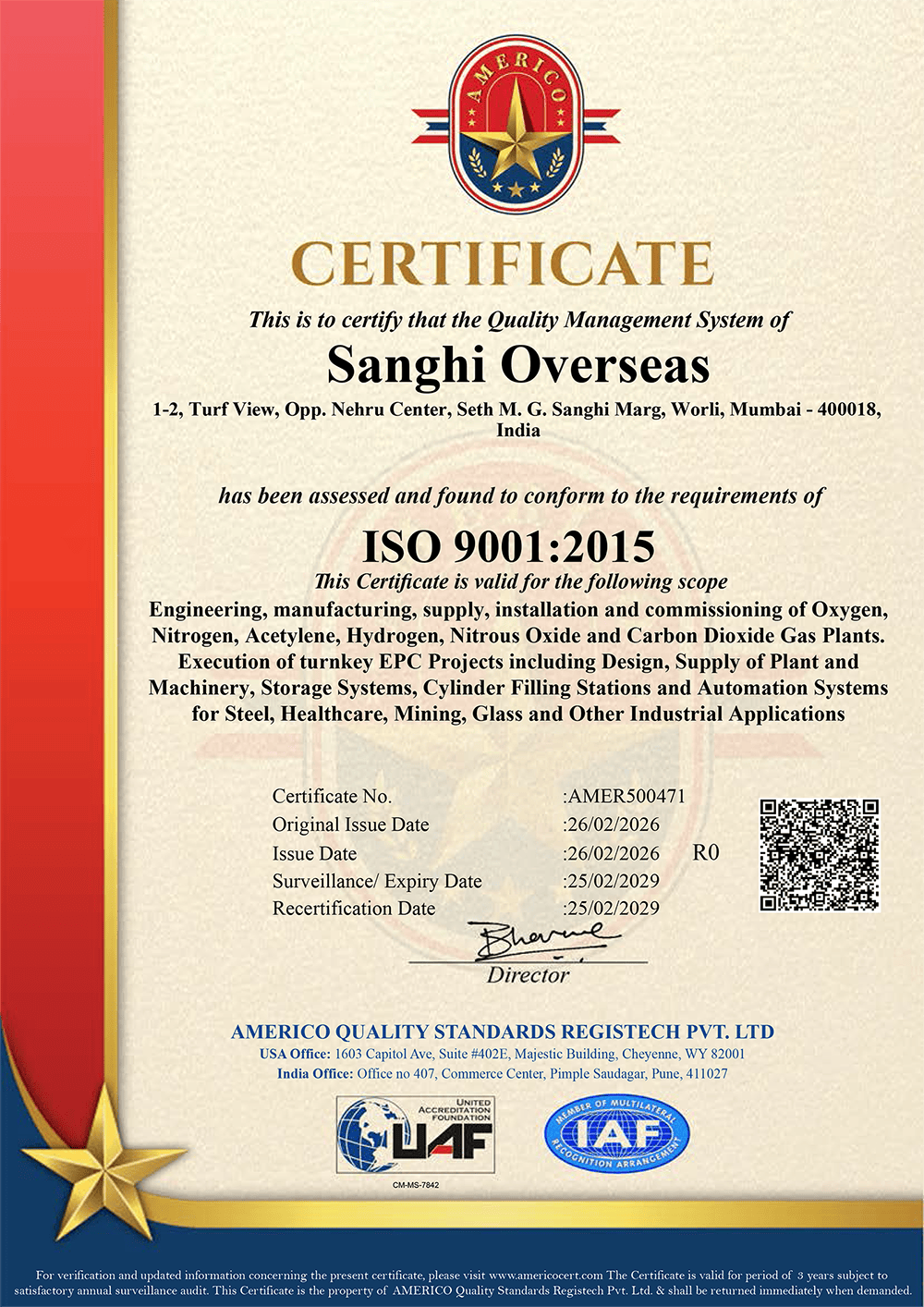
Sanghi Overseas has been an established oxygen plant supplier since 1969, exporting cryogenic gas plants to more than 90 countries across Africa, the Middle East, Southeast Asia, South Asia, and beyond. As an ISO 9001:2015 certified manufacturer, our production processes, materials sourcing, and quality assurance protocols meet international benchmarks.
Our oxygen gas plant product range includes
- SANGHI-O RG Series: Capacities from 80 to 1,000 m³/hr of gaseous oxygen at 99.6% purity
- Simultaneous nitrogen output from 96% to 99.9999% purity
- Cryogenic liquid oxygen and liquid nitrogen plant variants
- Custom-engineered plants for non-standard altitude, temperature, or purity requirements
- Full ancillary supply: air compressors, expansion engines, liquid pumps, cylinder filling manifolds, storage tanks
Every oxygen gas plant we deliver is backed by comprehensive operator training, lifecycle maintenance guidance, and a dedicated spares inventory programme — ensuring that your plant continues performing at rated capacity for its full operational life.
Choosing the Right Oxygen Gas Plant: A Buyer's Checklist
Before approaching any oxygen plant supplier, clarify the following requirements to ensure you receive accurate technical and commercial proposals
- Required oxygen output in m³/hr and target purity percentage
- Whether simultaneous nitrogen production is needed, and at what purity
- Whether liquid oxygen or nitrogen tapping is required
- Available site area and maximum assembly height
- Utility availability: power rating, cooling water supply, ambient temperature range
- Local regulatory requirements for industrial and medical gas production
- Budget envelope and expected payback period
- After-sales service expectations and spare parts logistics
Sharing these parameters upfront allows a qualified oxygen plant supplier to deliver a precise, technically matched proposal — and helps you make a true apples-to-apples comparison across vendors.
Conclusion
The decision to invest in an on-site oxygen gas plant is one of the most consequential infrastructure decisions a gas distributor, hospital, steel plant, or industrial facility can make. Selecting the right oxygen plant supplier — one with proven engineering, global field experience, and transparent support commitments — determines whether that investment delivers for decades or underperforms from the start.
Sanghi Overseas brings over five decades of focused expertise to every oxygen gas plant project. We understand what high-purity production demands — technically, operationally, and commercially. Whether you are evaluating your first plant or expanding an existing facility, we invite you to speak with our specialists and receive a proposal tailored to your specific requirements.
Understanding oxygen plant cost in India goes beyond the equipment price — it is about evaluating the full lifecycle value of a system that will serve your business for 20+ years. We are here to help you get that calculation right.
Ready to explore your oxygen gas plant project?
Contact Sanghi Overseas today for a customised consultation and quote.
www.sanghioverseas.com/oxygen-nitrogen-gas-plant-manufacturer
Frequently Asked Questions
Answers to the questions buyers and plant operators ask most often about oxygen gas plant systems, costs, and capabilities.
Q: What is an oxygen gas plant and how does it work?
An oxygen gas plant is an on-site industrial facility that produces high-purity oxygen directly from atmospheric air using cryogenic air separation technology. Air is compressed, purified through molecular sieve dryers to remove moisture and impurities, then cooled and liquefied. Oxygen and nitrogen are separated based on their different boiling points inside distillation columns. The resulting oxygen — typically at 99.6% purity — is then compressed and delivered for industrial or medical use, or used to fill cylinders directly on-site.
Q: What is the oxygen plant cost in India?
Oxygen plant cost in India varies significantly based on production capacity, purity requirements, and whether liquid oxygen or nitrogen tapping is needed. A smaller 80–100 m³/hr plant will carry a considerably different price tag than a large 600–1,000 m³/hr industrial system. Beyond the equipment itself, total project cost includes civil construction, electrical infrastructure, cooling water systems, installation, commissioning, and training — which can represent 30–50% on top of equipment cost. For an accurate oxygen plant cost in India for your specific requirements, contact Sanghi Overseas for a tailored quotation.
Q: How do I choose the right oxygen plant supplier?
When evaluating an oxygen plant supplier, look beyond the headline equipment price. Key criteria include: proven field installations and reference sites, energy efficiency benchmarks (target 1.0 kWh/m³ or below at scale), after-sales service capability in your region, spares availability, quality certifications such as ISO 9001:2015, and the supplier's ability to customise the plant to your specific purity, capacity, and infrastructure requirements. A reliable oxygen plant supplier should also provide operator training, commissioning support, and a lifecycle maintenance programme.
Q: What purity levels can an oxygen gas plant achieve?
A cryogenic oxygen gas plant can consistently achieve oxygen purity of up to 99.6%, which meets both industrial and medical-grade standards. Sanghi Overseas plants simultaneously produce nitrogen at purities ranging from 96% up to 99.9999%, depending on the configuration. High-purity nitrogen of up to 1 PPM can also be tapped in modified plants with a separate liquid nitrogen pump. These dual-output capabilities allow operators to serve multiple market segments from a single oxygen gas plant investment.
Q: What industries use oxygen plants?
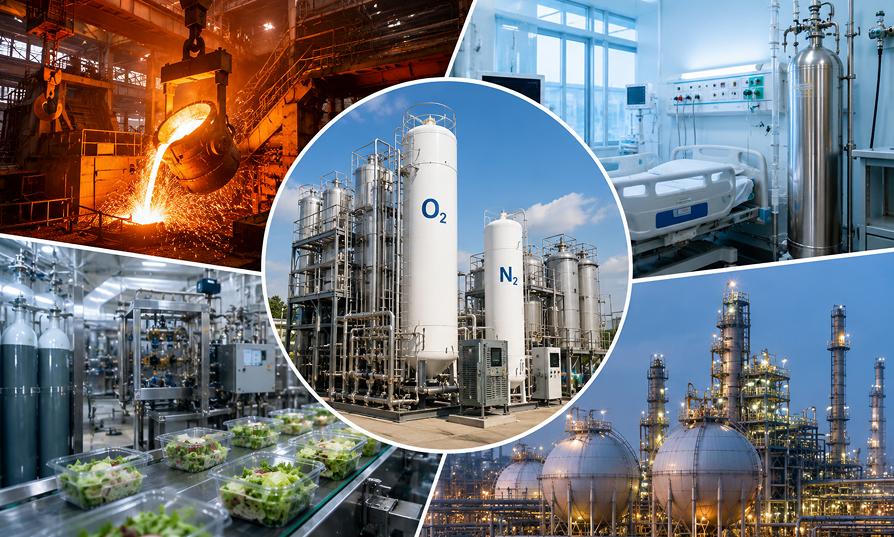
Oxygen gas plants serve a wide range of industries. In healthcare, they supply medical-grade oxygen to hospitals, clinics, and emergency services. In manufacturing, they support oxy-fuel cutting and welding in metal fabrication, blast furnace enrichment in steel plants, and glass and ceramic melting. Other major users include the chemical and pharmaceutical industries, water treatment facilities, aquaculture operations, and paper and pulp producers. Nitrogen output from the same plant finds applications in food packaging, electronics manufacturing, oil and gas operations, and laboratory environments.
Q: How long does it take for an oxygen plant to pay back its investment?
For medium-to-large oxygen consumers, on-site production via an oxygen gas plant typically achieves full investment payback within three to five years. Payback is driven by the elimination of recurring third-party cylinder or liquid oxygen costs, independence from supply chain volatility, and the ability to generate additional revenue from nitrogen sales. The lower the current third-party gas procurement cost, the longer the payback period — making it essential to model total cost of ownership carefully. A qualified oxygen plant supplier like Sanghi Overseas can assist with a detailed ROI analysis specific to your consumption profile.
Q: Can an oxygen plant also produce nitrogen?
Yes. Cryogenic oxygen gas plants are inherently dual-product systems. Sanghi Overseas plants simultaneously produce high-purity oxygen (up to 99.6%) and nitrogen (from 96% up to 99.9999%) without significant additional capital cost. This dual-production capability is one of the most commercially compelling features of cryogenic technology — operators can serve industrial nitrogen customers in food processing, electronics, and chemicals alongside their core oxygen business, from a single plant investment.
Q: What capacity oxygen plant do I need?
The right oxygen gas plant capacity depends on your current and projected oxygen consumption, the number of cylinders you fill per day, and whether you intend to supply third parties. Sanghi Overseas offers cryogenic plants from 80 m³/hr up to 1,000+ m³/hr of gaseous oxygen output. As a general guide, if you are filling 50–100 cylinders per day, a 100–200 m³/hr plant is typically appropriate. Larger industrial consumers or commercial distributors may require 300–600 m³/hr or above. Our team can help you model the right capacity based on your specific demand data.
Q: Does Sanghi Overseas export oxygen plants internationally?
Yes. Sanghi Overseas has been exporting oxygen gas plants since 1969 and has completed 1,100+ installations across 90+ countries, spanning Africa, the Middle East, Southeast Asia, South Asia, and other global markets. As an ISO 9001:2015 certified manufacturer and https://www.sanghioverseas.com/, Sanghi Overseas manages the full project lifecycle — from equipment supply and sea freight to on-site commissioning, operator training, and long-term after-sales support — regardless of the buyer's geography.
Q: How do I get a quote for an oxygen plant from Sanghi Overseas?
To receive an accurate quote from Sanghi Overseas, share your required oxygen output capacity (m³/hr), target purity, whether simultaneous nitrogen production is needed, your site location and available utilities, and any relevant infrastructure constraints. You can reach us through our website at www.sanghioverseas.com, by email at enquiry@sanghioverseas.com, or by phone at +91-22-2494-5464. Our team will respond with a detailed technical and commercial proposal tailored to your requirements.