

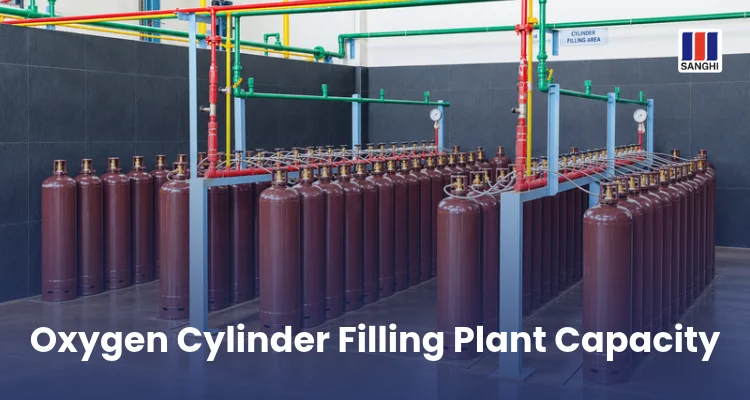
To calculate oxygen cylinder filling plant capacity, multiply your peak daily cylinder demand by the oxygen required per refill, allow for growth and filling losses, then divide by effective production hours. The result is the oxygen output required in m³/hr.
Cylinder specifications, operating hours, gas quality and filling equipment must support the same target. This guide explains the calculation and the checks before choosing a cryogenic oxygen plant.
Key takeaways
- Use an agreed gas requirement per refill, expressed on the same reference basis as plant output.
- Separate production availability, site output and filling losses instead of applying an unexplained percentage.
- Match oxygen quantity, purity, pressure and any nitrogen requirement within one confirmed operating alternative.
- Check filling equipment, utilities and backup supply alongside the hourly production figure.
- Base growth allowances on forecast demand, rather than a standard percentage.
- Round down when estimating complete cylinder refills.
- Confirm defrost duration separately from restart time.
- Assess medical oxygen demand and quality for the specific facility.
Why capacity calculation comes first
Capacity influences the air compressor, separation equipment, filling system, utilities and site layout. An undersized installation can delay deliveries; unnecessary capacity can increase investment and operating costs.
However, running cost depends on the selected equipment, operating load and control arrangement. A larger nameplate rating does not prove that a plant always consumes its full rated power. Compare proposed configurations at the output you expect to sell, including their specific energy consumption and maintenance requirements.
Start with demand records before selecting a model.
Step 1 Establish the oxygen required per cylinder refill
Cylinder water capacity describes its internal volume. It is different from the volume of free gas contained at a specified reference temperature and pressure.
A common preliminary shortcut is:
Approximate gas volume in m³ = water capacity in litres × pressure in bar ÷ 1,000.
Using that shortcut, a 47 L cylinder at 150 bar gives 7.05 m³. This is an idealised approximation, not an exact oxygen-content calculation or a filling instruction. It simplifies the pressure basis and assumes roughly matching temperatures.
An accurate pressure-based calculation accounts for absolute pressure, gas temperature and compressibility. The resulting gas quantity must then be expressed at the same reference conditions as the plant's quoted output.
Also establish the cylinder's return condition. Residual oxygen, evacuation and purging affect the fresh gas required. If measured refill consumption already includes handling losses, do not add those same losses again later.
Confirm water capacity, permitted filling pressure, valve requirements and applicable temperature limits from the cylinder specification. Do not choose 140 or 150 bar merely because it appears in an example. Bar and kgf/cm² are different pressure units.
Step 2 Convert peak daily demand into cubic metres
Step 3 Convert daily volume into hourly production
Divide design demand by effective production hours and filling yield:
Required output = design refill demand ÷ effective production hours ÷ filling yield.
Filling yield = 1 − process loss fraction.
Assume 21.6 effective production hours and a 4% process loss, giving a 96% yield:
Required output = 2,520 ÷ 21.6 ÷ 0.96 = approximately 121.5 m³/hr.
The hours, growth and loss values are example assumptions, not Sanghi performance guarantees. Replace them with the project operating plan and engineering estimates.
The 21.6 hours represent a 24-hour schedule at 90% production availability. This time allowance does not mean the plant delivers only 90% of its rated hourly output. Site conditions may require a separate output correction. Avoid counting the same reduction twice.
At 16 effective production hours, the same design demand would require approximately 164.1 m³/hr. Operating schedules can therefore change capacity selection.
Illustrative output and daily refills
This table assumes 21.6 effective hours, 96% filling yield, 7.0 m³ per refill and no other oxygen demand. Cylinder figures are rounded down.
| Available oxygen output | Gross daily oxygen | Complete refills per day |
|---|---|---|
| 100 m³/hr | 2,160 m³ | 296 |
| 120 m³/hr | 2,592 m³ | 355 |
| 150 m³/hr | 3,240 m³ | 444 |
| 200 m³/hr | 4,320 m³ | 592 |
These are arithmetic examples, not Sanghi model ratings. Under these assumptions, 120 m³/hr falls short of the 360-refill design target. A configuration providing 150 m³/hr would cover it, subject to the other equipment and site checks.
Find the Right Oxygen Plant Capacity for Your Cylinder Filling Needs
Step 4 Match capacity to purity and the operating alternative
PSA generation and cryogenic air separation differ in gas quality, pressure and equipment arrangement. Select against the complete application specification. The cryogenic plant process guide provides process context.
For Sanghi cryogenic plants, brochure tables show alternative oxygen and nitrogen operating cases. Each row links particular gas quantities, purities and product pressures. Do not combine the maximum oxygen quantity from one row with the nitrogen purity from another.
Confirm nitrogen available after internal requirements such as dryer regeneration, and discuss how liquid withdrawal affects gaseous oxygen production. Simultaneous nitrogen production does not automatically mean that a separate oxygen-only rating must be higher; use the supplier's confirmed operating case.
Review the oxygen gas plant specifications when comparing configurations. Ask for an offer at your site conditions, stating the gas-volume reference temperature and pressure.
Step 5 Check the filling system as well as the plant
Filling equipment can limit cylinder throughput even when oxygen production is sufficient.
In a liquid-pump arrangement, the cryogenic pump raises liquid oxygen pressure. It is then vaporised and warmed before reaching the filling manifold as gas. This differs from an oxygen-service compressor that raises the pressure of gaseous oxygen.
Confirm pump or compressor duty, vaporisation capacity, final delivery pressure and the cylinder filling procedure. A maximum pressure advertised for a product range is not necessarily the specification supplied with every model.
Manifold positions alone do not establish cylinders filled per hour. Bank arrangement, filling rate, connection changes, inspection and handling all matter. Changeovers need not stop the air separation plant if the system arrangement accommodates them.
The gas plant ancillaries and spares range includes supporting equipment such as valves, vaporisers, analysers and cylinder testing equipment. Confirm quoted inclusions and buyer-supplied equipment.
Check site conditions and shutdown coverage
Before finalising capacity, review these four areas:
- Ambient conditions: Share temperature range, altitude, humidity and intake-air conditions. Confirm available output at the actual site.
- Cooling water: Confirm circulation flow, inlet temperature and water quality. Circulating flow is different from fresh-water makeup consumption.
- Electrical supply: Confirm voltage, frequency, connected load, operating demand and starting requirements. Supply voltage alone does not establish the required electrical capacity.
- Defrost and restart: Obtain the maintenance interval, defrost duration and separate restart requirements for the selected configuration.
Defrosting is periodic. The brochures list defrost time separately from starting time after defrost, so an eight-hour restart figure should not be treated as the entire outage. Confirm when acceptable product quality and normal output will resume.
An annual availability allowance does not provide oxygen during a complete shutdown. Plan reserve cylinders or an alternative supply for the actual interruption. Agree production hours separately from filling shifts; a daytime filling operation does not automatically require daily cryogenic plant shutdowns.
Additional planning for medical oxygen
Hospital demand needs a facility-specific assessment covering ward types, patient numbers, oxygen use, equipment requirements and surge scenarios. A single litres-per-minute allowance for every general bed or high-demand outlet cannot establish the capacity required for all hospitals.
If the plant supports both pipeline supply and cylinder refilling, assess their simultaneous demand. Backup arrangements must also be assessed against the outage duration and the loads they must support.
Medical suitability requires more than an oxygen purity percentage. Applicable product specifications, testing, controlled manufacture and distribution, and local regulatory requirements must be addressed for the intended supply route.
How Sanghi Overseas can support your enquiry
Sanghi Overseas handles export enquiries for plants manufactured by Sanghi Organization. Prepare cylinder specifications, peak refill quantities, agreed gas volumes, required oxygen quality, other gas demands, operating schedules and site utilities.
Include growth plans, backup arrangements and filling-equipment requirements. These inputs support a defined engineering discussion and a relevant technical quotation.