


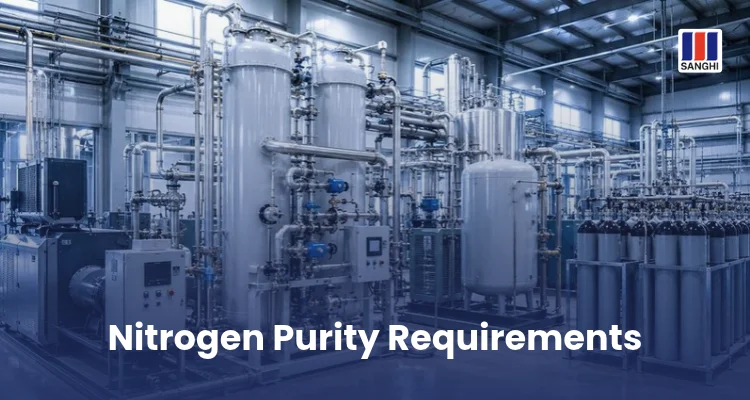
Nitrogen purity requirements should start with the impurities your process can tolerate. A usable specification combines those limits with the flow available at that quality and the minimum pressure needed at the point of use.
A percentage alone leaves important questions unanswered. Does it represent actual nitrogen content or an oxygen-based reporting convention? Is the flow before or after internal plant consumption? Where is pressure measured?
This guide helps engineers and procurement teams define those inputs for a cryogenic nitrogen plant enquiry, using practical industrial nitrogen plant examples.
Key takeaways
- Identify each critical impurity, rather than relying only on a purity label.
- State ppm by volume, or ppmv, when that is the required concentration basis.
- Confirm whether quoted purity includes argon or describes actual nitrogen content.
- Specify available nitrogen flow at the required quality and reference conditions.
- Distinguish usable nitrogen from gas consumed internally for dryer regeneration.
- Define minimum pressure at the point of use during peak demand.
- Give moisture limits a stated measurement and pressure basis.
- Agree suitable analysers, sampling locations and acceptance criteria before ordering.
How nitrogen purity is stated
For an actual nitrogen volume fraction, the non-nitrogen balance can be calculated as:
Non-nitrogen balance in ppmv = (100 − nitrogen percentage) × 10,000.
| Actual nitrogen content by volume | Non-nitrogen balance in ppmv |
|---|---|
| 98% | 20,000 |
| 99.5% | 5,000 |
| 99.9% | 1,000 |
| 99.99% | 100 |
| 99.9999% | 1 |
These are arithmetic conversions on the same declared analytical basis. If the percentage is a minimum nitrogen specification, the corresponding balance is a maximum. A dry-basis percentage does not independently establish the water content.
Check the reporting convention. Some nitrogen-generator suppliers calculate nitrogen-equivalent purity from residual oxygen, counting argon with nitrogen. That is different from measuring actual nitrogen content with all other gases treated as impurities. Do not assume that a Sanghi quotation follows either convention without confirmation.
An oxygen analyser measures oxygen. It cannot, by itself, establish limits for moisture, argon, carbon dioxide or every other contaminant.
Set impurity limits from the application
Identify what causes oxidation, product degradation or another unacceptable result. Obtain limits from the equipment maker, material specification, validated product testing or the responsible process team. An industry label such as electronics or pharmaceuticals does not define one universal nitrogen quality.
For example, suppose a machine specification limits oxygen to 50 ppmv. A quote stating 99.99% actual nitrogen allows up to 100 ppmv non-nitrogen balance, so it does not prove that oxygen stays below 50 ppmv. Ask for the oxygen limit separately.
Allowances for variation must reflect the application and measurement uncertainty. For safety-critical inerting, a generic instruction to add a small margin is insufficient. Use a competent, process-specific inerting assessment to establish operating limits, monitoring and supply reliability.
Share your application and impurity limits with Sanghi Overseas to discuss the nitrogen specification.
Specify nitrogen flow at the required purity
State peak and average demand, operating hours and which consumers can run together. Include short-duration demands such as purging, and discuss whether storage or another buffer is appropriate.
A daily total alone can hide a large demand over a short period. Provide the duration and frequency of those peaks. A receiver may help accommodate a brief peak, but it does not create extra nitrogen: the plant must still replenish the stored gas while meeting the continuing load.
| Model and case | Oxygen flow m³/hr | Nitrogen flow m³/hr | Nitrogen purity |
|---|---|---|---|
| ORG 200 case 1 | 200 | 700 | 98.00% |
| ORG 200 case 1A | 180 | 400 | 99.99% |
| ORG 400 case 3 | 400 | 1,600 | 98.00% |
| ORG 400 case 3A | 360 | 900 | 99.99% |
Get the Right Nitrogen Plant for Your Purity and Flow Requirements
Define flow units and reference conditions
A bare m³/hr figure is incomplete when its temperature and pressure basis are unknown. Normal and standard volume conventions also need explicit definitions.
Request the reference temperature, absolute pressure and dry or wet basis. Compare quotations only after reconciling these conditions. Also distinguish gas volume from liquid volume and specify whether the required product is pipeline gas, filled cylinders or liquid nitrogen.
Review nitrogen gas plant configurations alongside the complete requirement, rather than selecting a plant from flow alone.
Specify pressure at the point of use
Define the minimum pressure needed at the process inlet during peak flow. Account for losses across piping, filters, valves and regulators. State gauge or absolute pressure explicitly.
Plant product pressure, compressor discharge pressure and cylinder filling pressure describe different locations. A stated nitrogen pressure of 0.1 kg/cm² should not be interpreted as a promise of process pressure or cylinder filling capability.
Where higher pressure or cylinder filling is needed, confirm the separate compression or liquid-nitrogen pumping and vaporisation arrangement, its duty and its inclusion in the supply scope. A liquid oxygen pump description is not sufficient evidence of the nitrogen filling equipment offered.
Review your peak-flow and pressure requirements with Sanghi Overseas before finalising the filling or delivery arrangement.
Add moisture and other contaminant limits
If dryness matters, specify water concentration or dew point with the relevant basis. For pressure dew point, state the pressure at which the limit applies. A moisture concentration in ppmv and a dew point are related quantities, not interchangeable labels.
Changing sample pressure changes the measured dew point. Agree the sampling pressure and reporting convention, following suitable dew point sampling guidance.
Molecular sieves are used in cryogenic air separation systems to remove moisture and carbon dioxide from feed air. This does not replace a defined final-product moisture guarantee. Likewise, a claim such as 1 ppm must identify which impurity it limits; it cannot automatically establish both dryness and total nitrogen purity.
Match the technology and verification plan
The Sanghi plants discussed here use cryogenic air separation. PSA and membrane systems use different processes; their capabilities should not be transferred to the quoted cryogenic configuration. The cryogenic plant process guide provides a process overview.
Agree instruments suited to the specified contaminants and concentration ranges. Establish sample points at the plant acceptance boundary and relevant use points, together with calibration, sample conditioning and acceptance criteria. An online oxygen reading does not verify the full impurity specification.
For trace measurements, distinguish analyser resolution from measurement accuracy and the detection limit. A display showing a small number is not sufficient evidence of a guaranteed impurity limit. Agree the test method and suitable calibration gases.
Verify purity, flow and pressure together at the agreed operating condition. Define how startup, demand changes and off-specification gas are handled in the acceptance plan. Downstream contamination or a poorly conditioned sample line can also produce a reading that does not represent the plant product.
Sanghi's gas plant ancillaries and spares include analysers and supporting equipment. Confirm the actual measurement capability and project scope.
Why Sanghi Overseas for nitrogen specification
Sanghi Overseas supplies and exports industrial gas plants manufactured by Sanghi Organization in India. A useful enquiry connects your required gas quality, usable flow, delivery pressure and site conditions to the selected operating case.
Installation and commissioning support can be discussed as part of the project scope. Confirm responsibilities for utilities, piping, storage, cylinders and local approvals in the proposal.
Confirm the equipment and supply scope alongside the performance specification.
Information to include in your enquiry
- Application and each critical impurity limit, with its concentration basis.
- Peak and average flow, operating hours and gas-volume reference conditions.
- Minimum use-point pressure at peak demand, stating gauge or absolute.
- Moisture requirements, measurement points and acceptance criteria.
- Gas, liquid or cylinder-filling output, plus any simultaneous oxygen requirement.
- Project location, site utilities, expansion plans and supply responsibilities.
Conclusion
A usable nitrogen specification defines what is limited, how much compliant gas is available and where the required pressure must be maintained. Agree the measurement basis and verify the complete operating case.